Manganese Ore Market 2024 Review and 2025 Outlook [SMM Analysis]

Published: Jan 17, 2025 18:17
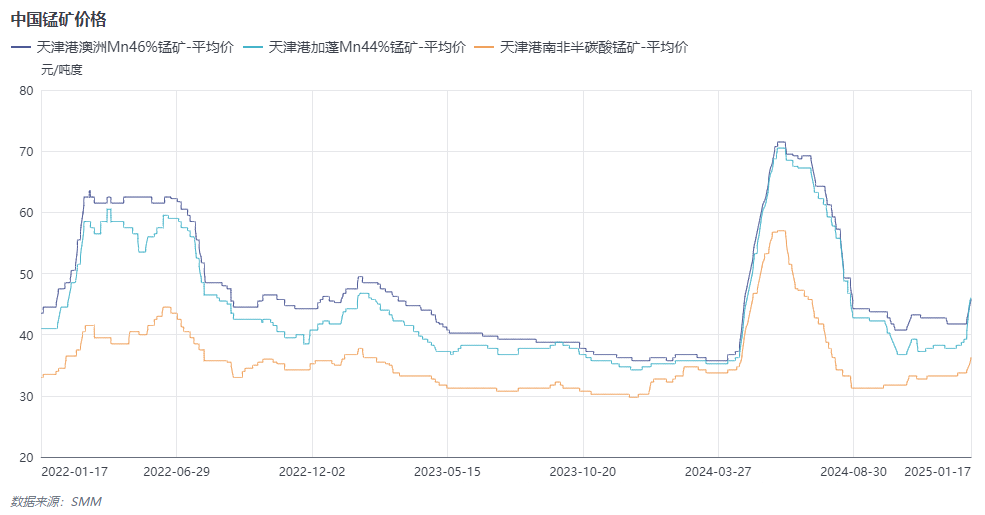
[SMM Analysis: Review of the Manganese Ore Market in 2024 and Outlook for 2025] I. Price: In 2024, the annual average price of 46% Australian lump at Tianjin Port was 47.66 yuan/mtu, up 16.02% YoY; the annual average price of 45.5% Gabonese lump at Tianjin Port was 45.72 yuan/mtu, up 17.77% YoY; and the annual average price of 37.5% South African semi-carbonate lump at Tianjin Port was 37.31 yuan/mtu, up 15.87% YoY. From the quarterly price review: 2024 Q1: Supply side, manganese ore port arrivals decreased MoM, but combined with previous manganese ore inventory, supply remained sufficient. Demand side, alloy plants mainly made just-in-time procurement, and port inventory destocking accelerated. Overall, despite just-in-time procurement by alloy plants, the supply surplus of manganese ore pressured price increases, leading to manganese ore prices fluctuating downward. 2024 Q2: Influenced by news of disruptions in mine shipments, overseas miners showed strong sentiment to stand firm on quotes. Supply side, manganese ore port arrivals continued to decline, and miners were reluctant to sell, resulting in tight market circulation. Demand side, alloy plants with manganese ore inventory showed strong willingness to resume production, and manganese alloy production increased, boosting procurement enthusiasm for manganese ore and significantly driving up spot prices.

I. Price Analysis:

The annual average price of 46% Australian lump at Tianjin Port in 2024 was 47.66 yuan/mtu, up 16.02% YoY; the annual average price of 45.5% Gabonese lump at Tianjin Port was 45.72 yuan/mtu, up 17.77% YoY; and the annual average price of 37.5% South African semi-carbonate lump at Tianjin Port was 37.31 yuan/mtu, up 15.87% YoY.

Quarterly price review:

2024 Q1: Supply side, manganese ore port arrivals decreased MoM, but combined with previous manganese ore inventory, supply remained sufficient. Demand side, alloy plants mainly made just-in-time procurement, and port inventory destocking accelerated. Overall, despite just-in-time procurement by alloy plants, the oversupply of manganese ore pressured price increases, leading to a downward fluctuation in manganese ore prices.

2024 Q2: Influenced by news of shipment disruptions at mines, overseas miners showed strong sentiment to stand firm on quotes. Supply side, manganese ore port arrivals continued to decline, and miners were reluctant to sell, resulting in tight market availability. Demand side, alloy plants with manganese ore inventory showed strong willingness to resume production, increasing manganese alloy production and boosting manganese ore procurement enthusiasm, which significantly raised spot prices.

2024 Q3: Supply side, manganese ore port arrivals increased. Demand side, downstream alloy plants, facing severe losses, showed low acceptance of high-priced manganese ore, leading to a slight reduction in production. Specifically, alloy plants in north China maintained high operating rates and procured manganese ore at lower prices, while those in south China operated at relatively low rates with weaker procurement enthusiasm. Overall, port inventory destocking was slow, and manganese ore spot prices fluctuated downward.

2024 Q4: Supply side, manganese ore port arrivals continued to increase, and combined with previous inventory, port stocks remained high. Demand side, alloy plant production also increased, maintaining just-in-time procurement of manganese ore. However, due to sufficient supply, alloy plants mainly procured at lower prices, causing manganese ore prices to continue fluctuating downward.
II. Imports:

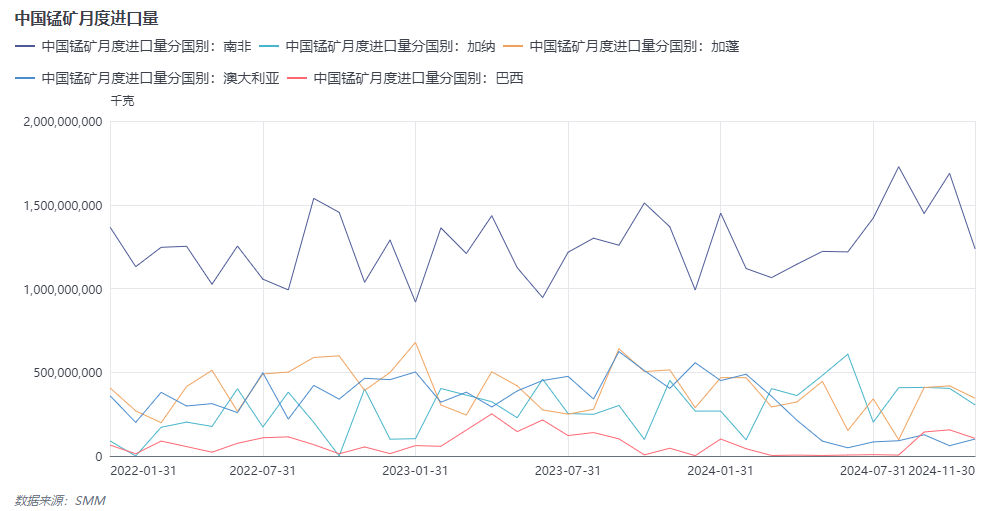
From January to November 2024, total manganese ore imports reached 26.7481 million mt, down 7.96% compared to 2023. The top five import sources were South Africa, Ghana, Gabon, Australia, and Brazil. Notably, in late March, South32 announced that shipments of Australian manganese ore scheduled for April were temporarily halted due to a tropical cyclone. On April 22, South32's Q3 report indicated that port operations were expected to resume in Q1 2025. Currently, there is no update on normal shipments from South32. If South32 resumes shipments in Q1 2025, manganese ore supply is expected to increase in 2025.
III. Demand:

Manganese oxide ore is primarily used in SiMn alloy, ferromanganese alloy, and high-purity manganese sulphate. In 2024, due to the overall rise in imported manganese oxide ore prices, especially the significant increase in high-grade manganese oxide ore prices, alloy plant profit margins were squeezed. Alloy plants actively adjusted manganese ore ratios, increasing the use of manganese-rich slag and South African semi-carbonate manganese ore. In south China, demand for domestic manganese oxide ore increased.

IV. Supply and Demand:

Due to the oversupply of manganese ore in 2023, this surplus carried over into 2024, ensuring ample market supply. Additionally, in 2024, with declining manganese alloy production and low acceptance of high-priced manganese ore, demand for imported manganese ore decreased. Overall, the manganese ore market faced an oversupply.

V. Outlook for 2025:

Demand side, SiMn production in 2024 was at a five-year low. Although SiMn currently faces overcapacity, SiMn plants aim to enhance competitiveness and reduce costs, with new commissioning plans in place. SiMn production is expected to increase slightly in 2025, driving higher manganese ore demand.

Supply side, with South32 planning to resume manganese ore shipments in Q1 2025, supply is expected to increase.

Regarding spot prices, the resumption of South32's Australian manganese ore shipments will impact the manganese ore market. Given the current oversupply situation, the market is expected to remain in a state of oversupply, with prices fluctuating at low levels.


》Subscribe to view historical price trends of SMM manganese products

Data Source Statement: Except for publicly available information, all other data are processed by SMM based on publicly available information, market communication, and relying on SMM's internal database model. They are for reference only and do not constitute decision-making recommendations.

For any inquiries or for more information, please contact: lemonzhao@smm.cn
For more information on how to access our research reports, please contact:service.en@smm.cn
Related News
[US Steel Imports Up 5.9% MoM to 1.874 Million Short Tons in April]
25 mins ago
[US Steel Imports Up 5.9% MoM to 1.874 Million Short Tons in April]
Read More
[US Steel Imports Up 5.9% MoM to 1.874 Million Short Tons in April]
[US Steel Imports Up 5.9% MoM to 1.874 Million Short Tons in April]
The American Iron and Steel Institute recently reported that the US imported a total of 1.874 million short tons of steel in April 2026, including 1.378 million short tons of finished steel, up 5.9% and 5.5% respectively from March. From January to April 2026, total US steel imports were 6.972 million short tons, down 29.5% MoM, while finished steel imports stood at 5.118 million short tons, down 30.5% MoM. The finished steel import market share in April is estimated to be 16%, and for the first four months of 2026, 15%.
25 mins ago
[Where Did the 2 Trillion Yuan in Household Deposits Go?]
30 mins ago
[Where Did the 2 Trillion Yuan in Household Deposits Go?]
Read More
[Where Did the 2 Trillion Yuan in Household Deposits Go?]
[Where Did the 2 Trillion Yuan in Household Deposits Go?]
May's financial data were released, and the topic of "deposit migration" once again sparked market attention. Data recently released by the central bank shows that after a decline of 1.94 trillion yuan in April, household deposits continued to shrink by 110 billion yuan in May, with a total reduction of 2.05 trillion yuan over the two months. This marks a rare occurrence in nearly a decade of household deposits posting negative growth for two consecutive months. Over the same period, deposits at non-bank financial institutions increased by a combined 3.61 trillion yuan, with the "seesaw" effect persisting. Another phenomenon that has drawn significant attention is the continued deleveraging in the household sector: in May, household loans decreased by 141.2 billion yuan, with a YoY decline that widened by 195.2 billion yuan (compared to an increase of 54 billion yuan in the same period last year). Industry experts have repeatedly noted that the flow of household deposits to non-bank institutions merely changes the structure of bank deposits, and this trend precisely reflects the deepening of China's financial market. A more noteworthy positive signal is that as the growth rate of household deposits continues to pull back, the "scissors gap" between it and the growth of M2 (broad money) continues to narrow and has remained negative for five consecutive months, indicating a trend of marginal fund mobilization. Some institutional sources believe that the capital cycle from households to enterprises and non-bank institutions is restarting, building momentum for the improvement of the domestic economic cycle.
30 mins ago
[US and Iran Have Reached a Peace Agreement]
32 mins ago
[US and Iran Have Reached a Peace Agreement]
Read More
[US and Iran Have Reached a Peace Agreement]
[US and Iran Have Reached a Peace Agreement]
Trump: The deal with Iran has now been reached. Congratulations to all! I hereby fully authorize free passage through the Strait of Hormuz, and simultaneously authorize the immediate lifting of the US maritime blockade. Ships of the world, start your engines. Let the oil flow! Pakistan Prime Minister Sharif Shehbaz stated: "After several rounds of intensive negotiations, we are pleased to announce that the US and Iran have reached a peace agreement. Both sides have declared an immediate and permanent cessation of military operations on all fronts, and hostilities within Lebanese territory have also been concurrently halted. The official signing ceremony of the agreement will take place on Friday, June 19, in Switzerland. We commend the United States and the Islamic Republic of Iran for their commitment to resolving the conflict through diplomatic channels. At the same time, we extend sincere gratitude to the leadership of Qatar, whose mediation efforts provided substantial support in finalizing this agreement. Special thanks are also due to the visionary leadership of the Kingdom of Saudi Arabia and the Republic of Turkey, both of which made immense contributions. The agreement has now been finalised, and the mediators will lead a series of talks this week. These preliminary consultations ahead of implementation will lay a solid foundation for subsequent technical negotiations and the formal signing ceremony."
32 mins ago